
Offices, shops, workshops and storage units across Manchester and the surrounding towns.
A house move ends when the boxes are in. A business move ends when the business is working again.
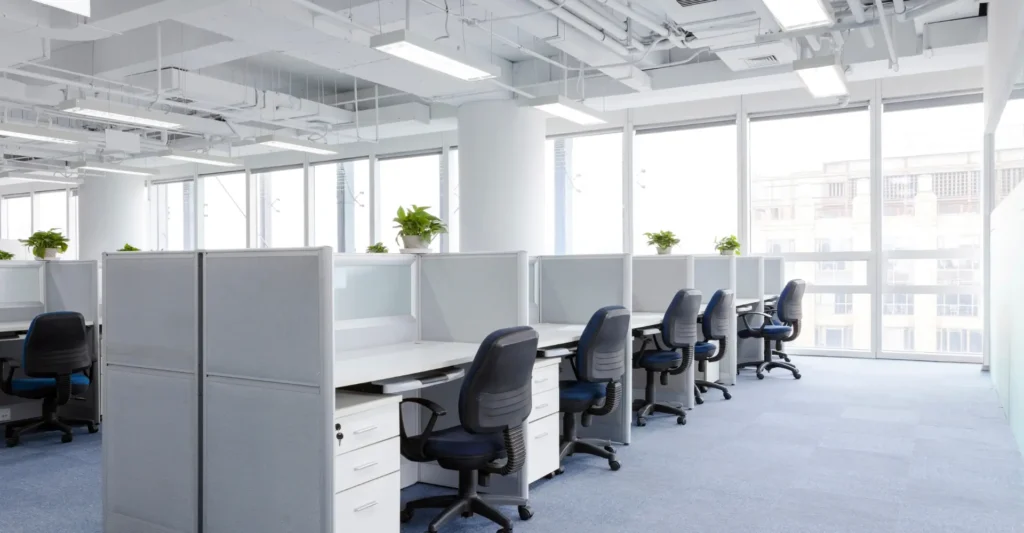
The furniture part is the easy half.
What makes a commercial move different is that something has to be working at the other end, usually by a particular morning. Staff need somewhere to sit. Phones need to ring. Whatever the business actually does needs to be possible again.
That changes what matters. On a house move the question is how much there is. On a business move the question is what has to be running first, and everything else is arranged around the answer.
The first thing worth deciding, before anybody quotes, is this: what has to work on the first morning?
For one business that is six desks and the internet. For another it is a stockroom and a till. For another it is a workshop with the machines plugged in. Tell us that at the start and the rest of the planning has something to organise itself around.
Business removals vary more than domestic ones, which is why a description is more useful than a category.
If your premises is a mix of those, say so. Most are.
Almost every commercial move comes down to the same three, and having answers makes everything quicker.
None of that needs solving before you get in touch. It is simply what the conversation will cover.
Almost every business move leaves something behind, and it is usually furniture that suited the old space and does not suit the new one.
It is worth deciding early rather than on the day, because three piles make everything simpler: coming with you, going elsewhere, and staying put. Anything still undecided by moving day tends to get loaded, which means paying to move something nobody wanted.
If some of it is going to a different destination, or into storage while a decision gets made, that is ordinary and can be quoted as one job. Just mention it at the start.
The move out is half the job, and the half that gets planned last.
Most commercial leases have something to say about the state the premises is returned in. What that means in practice varies enormously, so it is worth reading what yours actually says before assuming.
Whatever it turns out to require, knowing it before the move is booked is better than discovering it afterwards. If it affects what needs moving or when, tell us and it gets built into the plan rather than bolted on.
We have standard services and for most business moves one of them is the simplest way to book.
Some do not fit. A move split across two weekends. Part of the premises going into storage while a refit finishes. Two sites combining into one. An overnight move because the business cannot close. A stockroom going one way and an office going another.
Say so and we will tell you what can be arranged around it. The quickest route is the form. Give us the outline and we will come back to you.
Tell us the type of premises, roughly how big, what has to be working first, and the access at both ends.
We are a Manchester removals company based at Swan Street in the city centre, so most of Greater Manchester is a short run rather than a journey. Commercial removals further afield are arranged too, including moves out of the region.
It is one of the most common requests for commercial removals, and it is worth raising at the first conversation because it affects availability more than anything else.
Sooner is better for business moves than domestic ones, because the date is usually fixed by a lease rather than by choice. Ask even if it is short notice.
Yes, and plenty of businesses do. Mention it at quote stage so the whole thing is priced as one job rather than two.
Tell us what state things will be in and we will factor it in. It is a normal question, not a test.
Tell us what you have and who looks after it. If there is an IT provider involved, the earlier everyone is on the same timeline the better.
Tell us what it is and where it should go, and we will tell you what can be arranged.
Tell us the type of premises, roughly how big, what has to be working first, and the access at both ends.
RCM Removals
20 Swan Street, Manchester M4 5JW
Telephone: 0161 768 2056
Email: info@removalscompanymanchester.co.uk